The European Starling (Scientific name - Sturnus vulgaris) is also known as the Common Starling. Their name comes from the fact that they have short wings and resemble stars in flight. They are found throughout North America, having been introduced in New York in the nineteenth century by Shakespeare enthusiasts. They are also found throughout Europe and into the Middle East. They have been introduced in Australia, New Zealand and South Africa. They look black, but have a purplish green iridescence. In winter they are brown with white spots. Photos taken in Vancouver in December 2013 (top) and April 2014 (middle) and Surrey in March 2014.
The Purple Gallinule (Scientific Name - Porphyrio martinica) is also sometimes known as a "swamp hen". These birds are in the rail family and resemble coots and moorhens. They range from the southern U.S, through the Caribbean and Central America and down into South America, as far south as Argentina. They have large feet and can be seen walking across floating vegetation. They have a dark purple neck and underside and a green back. Their bill is red with a yellow tip and they have a blue forehead. Legs and feet are yellow. Photos taken in March 2014 in the Florida Everglades near Weston, Florida.
The Palm Warbler (Scientific name - Setophaga palmarum) is a small songbird that is found in the eastern part of North America as far north as Canada and south into the Caribbean. It has a rusty cap and yellowish underparts. These birds are distinctive as they are always wagging their tails. These photos were taken in March 2014 on Little San Salvadore Island
(Half Moon Cay) in the Bahamas.

The Green-winged Teal (Scientific name - Anas crecca) is a small dabbling duck found throughout North America. It breeds in Canada and Alaska and winters in the southern Caribbean and Mexico. It is a beautiful duck with the male having a distinctive rufous coloured head with a dark green ear patch. Photos were taken in March 2014 at the George C. Reifel Migratory Bird Sanctuary in Delta, B.C. and at Blackie Spit, Crescent Beach, Surrey, B.C.
 |
| Male |
 |
| Female |
The Bufflehead (Scientific name - Bucephala albeola) is a small diving duck found throughout North America. They range from Alaska to Mexico. The male is easily distinguished by the large white wedge at the back of its dark head. It has a dark back and white body. The head is somewhat iridescent and shows green to purple. The female is much more plain with a greyish brown body and darker back. The female head is dark brown with a oval white patch on the cheek.
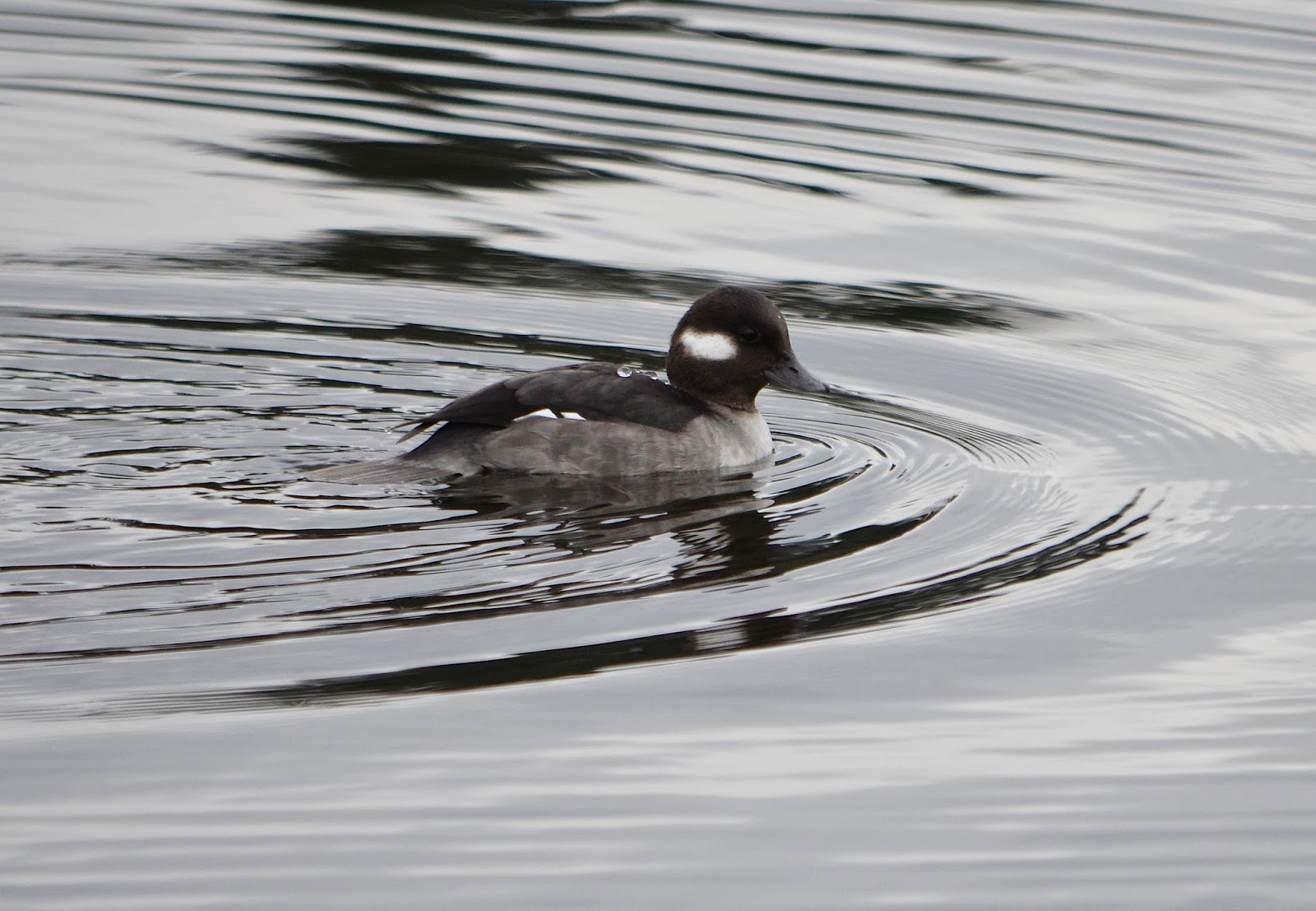 |
| Female |
The photos were all taken at Mill Lake, Abbotsford, B.C. between November 2013 and January 2014.
 |
| Male |
The Hooded Merganser (Scientific name - Lophodytes cucullatus) is the smallest of the mergansers. The males and the females both have crests that they can raise or flatten. This species is found in both the Eastern and Western parts of North America. They are medium distance migrants and many stay resident if the waters remain ice free. The males are very distinctive with a black and white head and black and white back and brown undersides. The females are mainly shades of brown and grey.
Photos were taken at Mill Lake, Abbotsford, British Columbia in January 2014.
 |
| Female |
 |
| Male |
The Golden-crowned Sparrow (Scientific name - Zonotrichia atricapilla) is a ground foraging sparrow found along the Pacific Coast of North America from Alaska and as far South as Baja California. It is distinguished by it's yellow crown which becomes more predominate in breeding males.
Photos taken in January 2014 at Elgin Heritage Park, Surrey, B.C.
The Barrow's Goldeneye (Scientific name - Bucephala islandica) is a medium sized diving duck. It is found primarily in the Western part of North America near the Pacific Coast and breeds as far north as Alaska and the Yukon Territory. There is a smaller population on the East Coast .
The Barrow's Goldeneye male is predominately black and white with a purple gloss to the head. There is a distinctive bold white facial crescent and white "piano key" marlins on it's sides. The female is duller in colour with a brown head and a brownish grey body.
 |
| Male and Female |
Photos taken in January 2014
at Stanley Park, Vancouver, B.C.
The Chestnut-backed Chickadee (Scientific name - Poecile rufescens) is the smallest of all the chickadees. They are found along the Pacific Coast of North America from Alaska down to California. They are identifiable from their rich chestnut coloured back.
Photos taken in January 2014 near Beaver Lake, Stanley Park, Vancouver, B.C.


