Monday, April 27, 2015

Gadwall

The Gadwall (Scientific Name - Anas strepera) is a dabbling (puddling) duck found across North America, although more prevalent in the West. They range from Alaska down into Mexico and Central America. It is slightly smaller than the more common Mallard and the females of the species look similar. The male has a round brown head, and a grey brown and black body with finely patterned flanks and breast. They have a black patch on the upper tail. Photos taken at the Colony Farm Regional Park, Port Coquitlam, B.C. in April 2015.
Male


Female

Yellow-headed Blackbird

The Yellow-headed Blackbird (Scientific Name - Xanthocephalus xanthocephalus) is found across the Western part of North America. They breed as far North as the Northern part of the four Western Canadian Provinces and winter as far South as Mexico. They are a fairly large blackbirds with a distinctive yellow head and chest, black bodies with a white stripe along the wing.They prefer wetlands and can be aggressive to other species in these areas such as the smaller Red-winged Blackbird and Marsh Wrens. While not always common on the West Coast, these photos were taken in April 2015 at the Iona Beach Regional Park in Richmond, British Columbia.


Tuesday, April 21, 2015

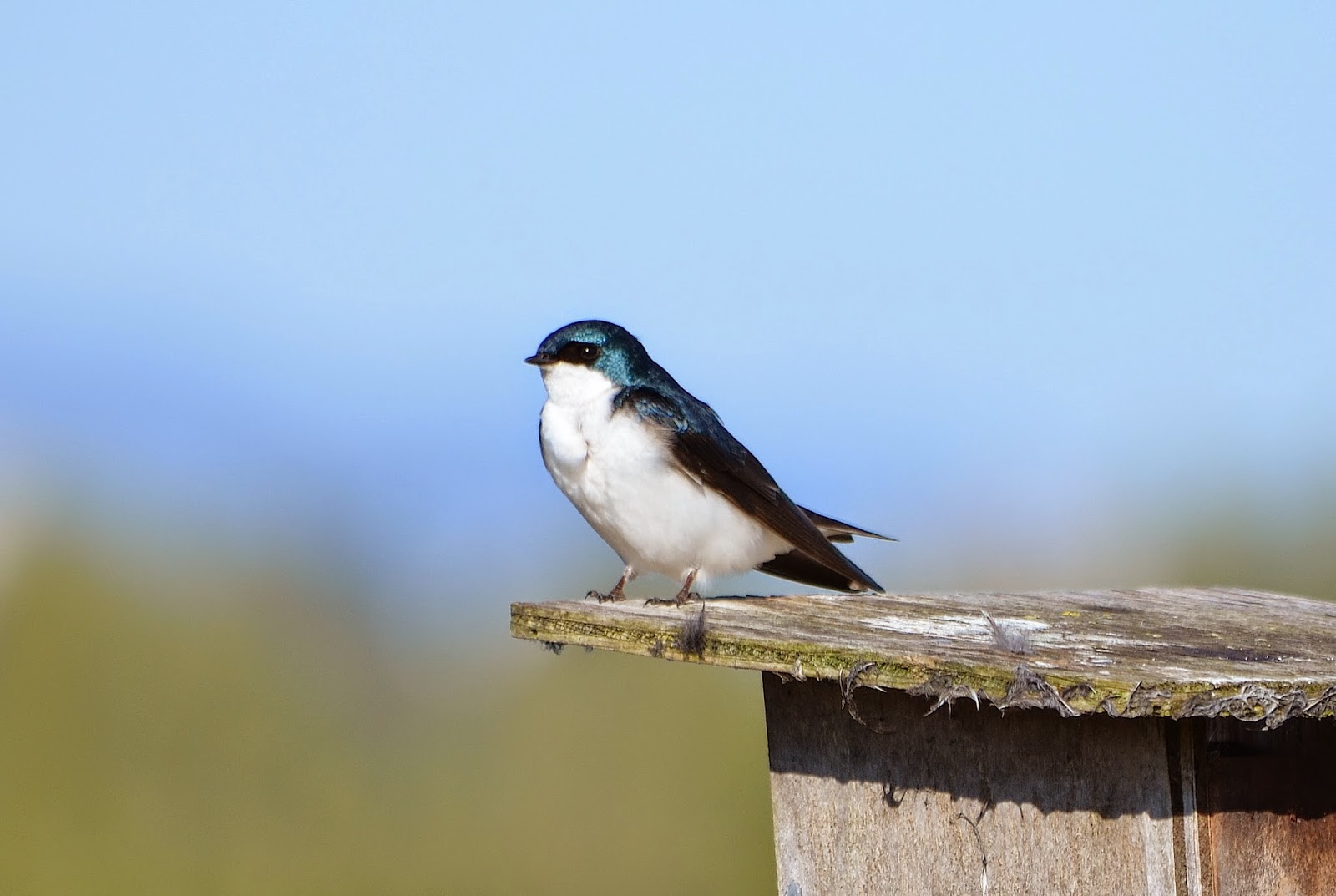
Tree Swallow

The Tree Swallow (Scientific Name - Tachycineta bicolor) is probably the most commonly seen swallow in North America. They can be found throughout Canada and the U.S.A. as far north as Alaska. They range south in winter to Mexico and Central America. They have a streamlined body, pointed wings and a notched tail. They have a bluish green back and head with a white underbelly. The bluish green appears iridescent. Females and immature males have more brown showing.  Photos were taken in April 2015 at the Iona Beach Regional Park, Richmond, B.C.


Wednesday, March 25, 2015

Downy Woodpecker

The Downy Woodpecker (Scientific name - Picoides pubescent) is a small woodpecker that is found throughout North America. They range from Florida to Alaska. They are often seen at feeders or in parks. They can be distinguished from the Hairy Woodpecker in that they are smaller have a shorter bill.  They are mainly black and white with a boldly striped head and a white stripe down the back.  The males have a distinguishing red patch at the back of the head. Photos were taken in Abbotsford and Richmond, British Columbia between November 2014 and January 2015.

Male


Female
  

Bushtit

The Bushtit, also sometimes known as the American Bushtit (Scientific name - Psaltriparus minimus) is a small songbird found in Western North America. They are found in small flocks and seem to be constantly on the move. They do not migrate, however sometimes in winter move from higher elevations down to lower ones. They are a bit smaller than the Chickadee and are mainly plain brown and grey. They have fairly large heads with a short bill and long tail feathers.  Photos were taken in Abbotsford, British Columbia in March 2015 and February 2014 (bottom photo). 


Pileated Woodpecker

The Pileated Woodpecker (Scientific name - Dryocopus pileatus) is a large woodpecker with a long neck and distinctive triangular red crest. The body is mostly black and the head has white stripes. The males have a red stripe on the cheek, while on the female it is black. They are a forest bird and use their long bill to drill holes in rotten wood to get insects. They are found in the Eastern United States to the East of the Mississippi and across much of Canada below the Territories and also down into Washington, Oregon and Northern California. Photos were taken in March 2015 at the Great Blue Heron Nature Reserve in Chilliwack, British Columbia.
Female


Male

Blue Jay

The Blue Jay (Scientific name - Cyanocitta crostata) is a noisy songbird that is found in the Eastern part of North America. They range from the Mid-west to the Eastern Seaboard in the United States and from the Gulf of Mexico and North into Central Canada and the Maritimes. Some can be found as far West in Canada as Alberta. They are very distinctive with a blue crest and white underbelly and blue, white and black plumage. These photos were taken in March 2015 in New Brunswick. 

Saturday, January 3, 2015

Red-breasted Merganser

The Red-breasted Merganser (Scientific name - Mergus serrator) is a diving duck found in many parts of North America. They range as far north as the Arctic and as far south as Texas and the Baja Penninsula. They are slightly smaller than the Common Merganser and have a long ragged looking double crest.  The males have a long orangish bill, dark head, white collar and reddish chest. The back is dark with white patches on the wings. In flight there are two noticeable dark wing bars. The female is mostly rusty brown and grey.  Photos were taken in Saint John, New Brunswick in December 2014. Unfortunately I did not get any photos of the females.


Tuesday, November 4, 2014

Anna's Hummingbird

The Anna's Hummingbird (Scientific name: Calypte anna) is a common hummingbird along the Pacific Coast of North America. They range from Northern British Columbia and the Alaskan panhandle down to the Northern part of Mexico.  They are mostly green (back) and grey with the males displaying iridescent colours (reddish pink to orange) on the throat (gorget) and head. Photos were taken in November 2014 at the Great Blue Heron Nature Reserve, Chilliwack, British Columbia.


Saturday, November 1, 2014

Belted Kingfisher

The Belted Kingfisher (Scientific name: Megaceryle alcyon) is found near streams and shorelines throughout North America.  It is distinctive with a large head with a shaggy crest and thick straight bill. They are light blue above with a white underside and a broad blue band on the breast. Females have a rust coloured band on their belly and are more brightly coloured than the males. There is also a distinctive white spot between the eye and bill. They range from Alaska and as far south as northern South America.  Photos taken in Richmond, B.C. (in flight), Langley, B.C. (on wire) and Chilliwack, B.C. in September (Richmond) and October 2014.